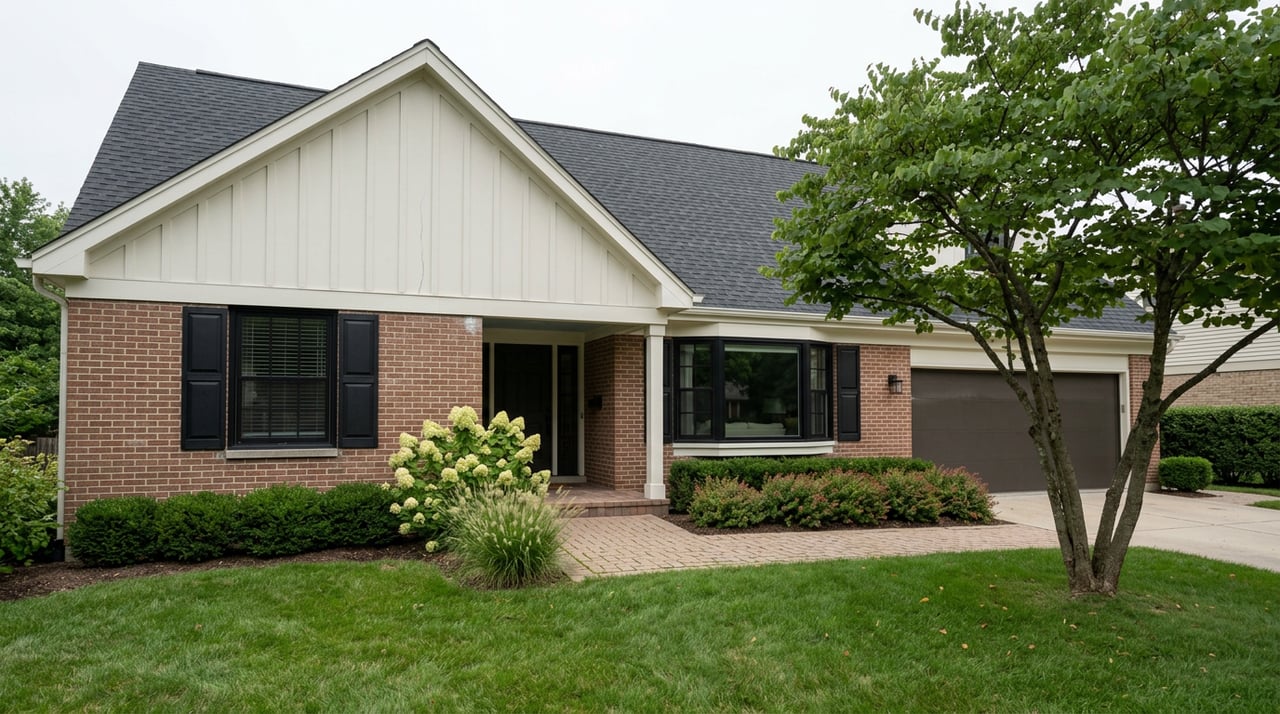
According to Larry in Fishers, Governor Mike Braun said, "I love the enterprising communities," at the ribbon-cutting for Fishers' final State Road 37 interchange on May 26, 2026. It was a good line for a ceremony. It also marked the quiet end of an eight-year commute bottleneck that has shaped how buyers value the east side of the city.
If you have been comparing Fishers to Carmel or Noblesville using the median price you saw on a portal search, you have been working with a number that no longer describes the market you are actually shopping in. The median blends a subdivision where homes list around $340,000 with a golf course community where they list for well over a million. And it was calculated before the road project that just replaced the stoplights along SR 37's Fishers stretch with roundabouts had time to show up in anyone's comps.
The Project That Just Finished
The State Road 37 Improvement Project started construction in 2018 and was originally estimated at $124 million. By the time crews finished the last piece, the 141st Street interchange, the final cost had climbed to $185 million. What buyers get for that money is a stretch of SR 37 running through Fishers that now moves through roundabout interchanges at 126th, 131st, and 141st Street, with a signal system in place for east-west traffic at 146th, instead of the traffic lights that used to back up the corridor for years.
Noblesville is still years out from doing the same thing on its stretch of SR 37. The city has only started evaluating future interchange options, with construction not expected to begin until at least 2028 or 2029. For now, the free-flow corridor is a Fishers advantage, and it is a brand-new one. The interchange opened less than three months before this was written.
That timing matters more than it looks. A road project doesn't show up in home values the day it opens. It shows up gradually, as buyers experience the shorter commute, as appraisers start using comps from after the change, and as sellers in the affected neighborhoods start testing higher list prices. Three months in, that process has barely started. Which means a buyer shopping the corridor right now is looking at prices set under the old commute, for a location that just got measurably better.
One City, Four Very Different Prices
Fishers had a median sold price of roughly $428,640 in June 2026, against a median listing price of $442,500 the same month. That single number is doing a lot of work to hide what is actually a handful of very different markets operating under one city name.
| Area | Typical Listing Price | What Sets It Apart |
|---|---|---|
| Brooks Chase | around $340,000 | the most affordable end of the city's named-subdivision range |
| Saxony | around $410,000 | sits close to the middle of Fishers' price spread |
| Avalon of Fishers | around $434,950 | tracks close to the citywide median itself |
| Gray Eagle | median around $674,000, individual homes from the $700,000s past $1.5 million | golf course community spanning low-maintenance condos to custom homes on the links |
Gray Eagle is worth a closer look, because the spread inside that one neighborhood tells the same story as the spread across the whole city. It is built around Gray Eagle Golf Club near 116th Street and Brooks School Road, about two miles east of I-69 and situated between 116th and 126th Street, which puts it in the same east-west band as the corridor's southernmost new roundabout at 126th. Its sub-neighborhoods, Woods at Gray Eagle, Links at Gray Eagle, and Hawks Landing at Gray Eagle, are served by Fall Creek Elementary, Fall Creek Intermediate, Fall Creek Junior High, and Hamilton Southeastern High School. Whether that proximity to the finished interchange starts showing up as its own premium is exactly the kind of thing a citywide median can't tell you.
A buyer comparing Fishers to Carmel on median price alone would never see any of this. They would see one city and one number. What they are actually choosing between is a $340,000 home in one part of town and a golf-course custom build well north of $1 million a few streets away, with a road project sitting nearby that just changed the commute math for the second one.
The Contradiction in the June Numbers
Here is where the market gets genuinely strange, and where a headline number would mislead you if you stopped reading after the first line.
In June 2026, Fishers' median listing price was down 9.49% year over year. Read alone, that sounds like a cooling market, the kind where buyers gain leverage and sellers start cutting prices out of necessity. But in that same month, the median sold price was up 7.16% year over year, and homes sold at a 100% sale-to-list ratio on average, meaning buyers paid essentially full asking price for what actually closed.
Those two numbers cannot both describe a simple slowdown. What they describe is sorting. Sellers, as a group, have gotten more conservative about where they set their opening ask. But the homes that are priced accurately are still moving fast and still commanding full value. The homes dragging the list-price average down are the ones sitting, waiting, and eventually getting cut, which never shows up in the sold-price figure because they have not sold yet.
Hamilton County's countywide numbers back this up. In June 2026 the county logged 2,359 active listings, 758 closed sales, and a 98.5% average sale-to-list ratio, with a median of 37 days on market. That is not a market where sellers are giving ground broadly. It is a market where the penalty for getting the number wrong has gotten sharper, even as the reward for getting it right hasn't moved.
Why the Overpricing Penalty Is Worse Than It Used to Be
A 2026 pricing study from Indiana REALTORS, covering more than 73,000 sales, put a real number on that penalty. Homes listed at their eventual sale price went under contract in a median of 7 days. Listed 2% too high, that stretched to somewhere between 6 and 42 days. At 4% too high, the range widened to 11 to 58 days. At 10% too high, it stretched all the way to 25 to 104 days.
Underpricing carried its own lesson. Homes listed 2% to 10% below their eventual sale price still sold quickly, typically in 2 to 12 days, but the speed advantage over accurate pricing was smaller than most sellers expect. Dramatic underpricing did not buy much.
In a market where list prices are already trending down citywide, a seller who misreads the correction and prices defensively, going lower than the data supports, is leaving money on the table for barely any speed benefit. And a seller who prices ahead of the market, assuming Fishers demand will absorb anything, is the one adding weeks or months to their timeline. The data says accuracy is the only lever that consistently works, and that has gotten more true, not less, as the citywide averages have started moving in different directions.
What This Means If You're Comparing Neighborhoods Right Now
The tightest micro-market in the city right now is ZIP 46037, one of Fishers' ZIP codes. Indiana REALTORS reported just 1.5 months of supply there in May 2026, 85 closed sales, and homes selling for 96.4% of original asking price. One weekly snapshot showed a listing price of $430,000 moving in 5 days on market, a noticeably faster pace than the citywide median of 37 days.
That kind of gap inside one ZIP code, let alone one city, is the whole argument. A buyer who anchors to the Fishers median and shops broadly is going to miss both ends of this market: the $340,000 tier that a citywide average makes look more expensive than it is, and the Gray Eagle tier where a just-finished, $185 million infrastructure project sits nearby and has not yet had time to show up in the price.
If you are comparing Fishers against Carmel, Westfield, or Noblesville, the honest answer is that "Fishers" is not one data point to compare. It is at least four, and one of them just got a commute upgrade that the market hasn't finished pricing.
FAQ
Is Fishers a buyer's market or a seller's market in mid-2026? Neither, cleanly. Citywide, sellers are adjusting list prices downward while sold prices and sale-to-list ratios stay strong for accurately priced homes. It behaves more like a market rewarding precision than one favoring either side broadly.
Which Fishers neighborhoods sit closest to the finished SR 37 corridor? Gray Eagle, positioned between 116th and 126th Street near Brooks School Road, sits in the same corridor band as the 126th Street roundabout, one of the newly completed interchanges. The project also rebuilt crossings farther north at 131st and 141st Street, with a signal system at 146th.
Should I wait to buy near the corridor until prices reflect the road project? There is no way to know how long that repricing takes or whether it happens at all. What the data shows is that the commute change is real and recent, and that current prices in the area were largely set before it existed.
If you are trying to figure out what a specific Fishers subdivision is actually worth today, not what the citywide median suggests, that is exactly the kind of comparison the Rasmussen Team works through with buyers and sellers across Hamilton County every week. Reach out for a free home valuation and a straight answer about what your target neighborhood is really doing right now.